Let me first address recording as a research methodology. Recordings are very useful tools to document how people actually use language in everyday practices. However, researchers need to be cognizant of culturally appropriate ways of making and using recordings, and always uphold ethical obligations to the people with whom they work. Ethnomusicologists and anthropologists have a troubled history in this regard, since early research was not always carried out with informed consent of those being studied, and communities often did not maintain control over how the recordings were used.
There is no justification for this history, aside from recognizing the limits of our ethical standards at any given moment. But paradoxically, many of the recordings produced under unethical circumstances have become a resource for cultural and linguistic revitalization in recent years, as younger generations use them to learn forgotten practices of their communities.
Contemporary researchers, at least those affiliated with universities, must follow much stricter guidelines for obtaining consent to make and use recordings. Those who work with indigenous communities often collaborate with them to develop research topics and methodologies that are desired and valued by the community itself.
The Miskitu people with whom I worked were open to recordings of various kinds, but I did make a difficult decision to use only audio recording rather than audiovisual recording. Recent language socialization studies have shown the special value of videorecording for capturing a rich interactive context that includes gesture and bodily stance. However, videorecording was not feasible in the public spaces on Corn Island in which children played, in a volatile social context where crime and random (or not so random) violence were a daily reality.
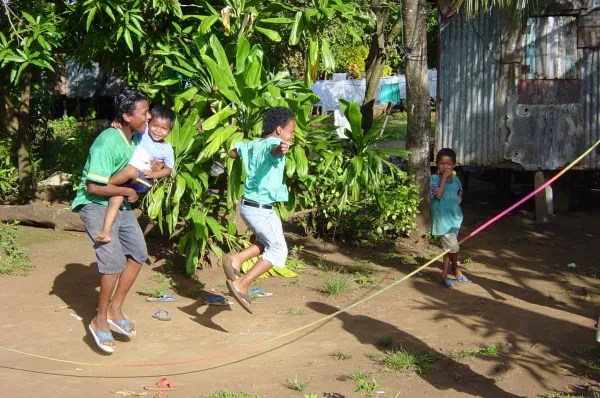
I used audio recording, which was much more discreet from the perspective of passers-by, along with detailed notes and photographs to document children's play activities. All forms of documentation create a representation of a social interaction rather than reproducing the interaction itself, but recordings still help to reveal the moment-by-moment negotiation of interaction, and to ground the analysis in specific interactions rather than relying on generalizations.
Understanding how people use language provides essential insights for designing and implementing effective language revitalization programs, as Barbra Meek has shown in her book in this series, We Are Our Language: An Ethnography of Language Revitalization in a Northern Athabaskan Community (University of Arizona Press, 2010).
Researchers have never had a monopoly on technology. Radio and recordings have long been a source of expressive repertoires on the Atlantic Coast of Nicaragua, evident for example in the regional popularity of classic U.S. country music like George Jones and Tammy Wynette. At the time of my study, Miskitu children on Corn Island were the first generation of their families to grow up with regular television viewing, somewhat delayed because of the irregular access to electricity and the relatively recent development of a satellite cable TV system on the island.
Some observers might view increased television viewing as a threat to native language maintenance, but I think it was actually part of a broader expansion of communicative resources that continued to include Miskitu and other regional languages (or language varieties). In chapter 5 of my book, I show how Miskitu kids enacted elaborate pretend play scenarios that involved characters and plots from Spanish-language TV shows, but they often voiced these characters in Miskitu, revealing a creative recombination of figures and voices.
On the mainland Atlantic Coast, community radio and television stations foreground regional languages and cultures, reclaiming technology for cultural and political imperatives at the local and regional level. In order to understand the impact of technology and media in any particular place, we must employ ethnographic methods to see what people are using in their daily lives and how they are using these forms of communication.